

Hard Carbon vs Graphite for Sodium-Ion Batteries: What’s the Difference?
Introduction
Graphite has been the dominant anode material for lithium-ion batteries for decades due to its stable layered structure, high conductivity, and excellent lithium intercalation capability. However, when researchers began developing sodium-ion batteries (SIBs), graphite showed significant limitations in sodium storage performance.
As sodium-ion technology continues to attract attention for large-scale energy storage applications, hard carbon has emerged as one of the most promising anode materials for commercial sodium-ion batteries.
But why does graphite work well in lithium-ion batteries while hard carbon performs better in sodium-ion systems?
This article compares hard carbon and graphite from the perspectives of structure, sodium storage mechanism, electrochemical performance, and commercialization potential.
Why Graphite Works Well in Lithium-Ion Batteries
Graphite has a highly ordered layered structure composed of stacked graphene sheets.
Lithium ions can reversibly intercalate between these layers during charging and discharging: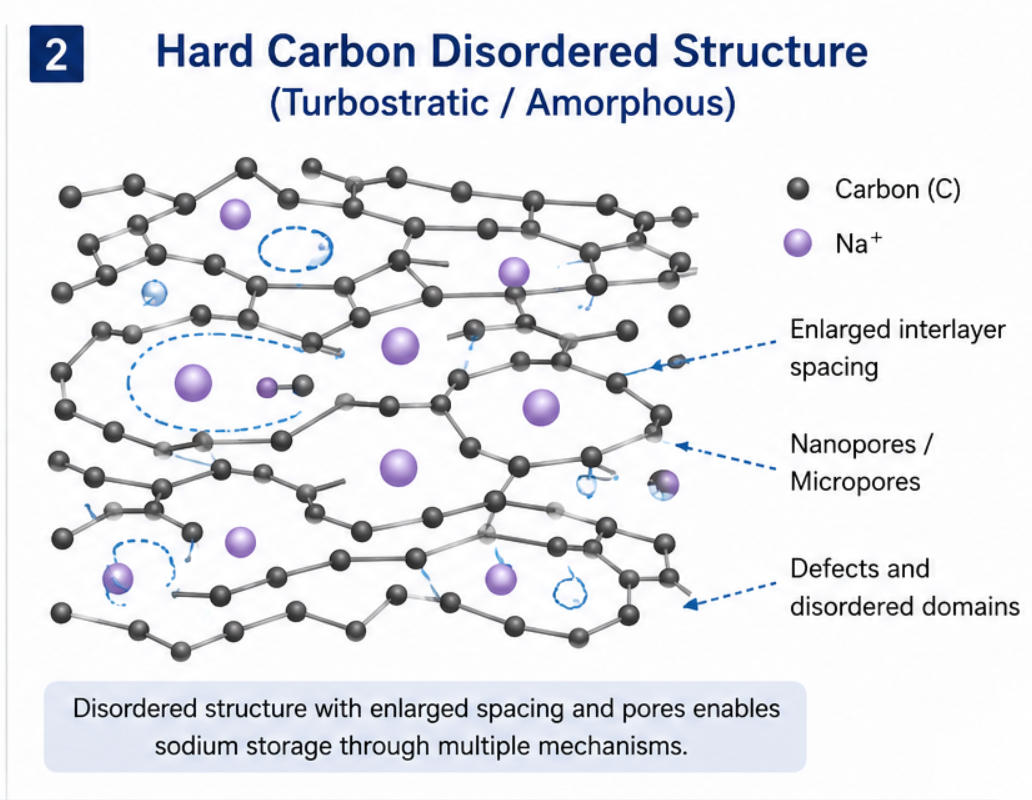
Because lithium ions have a relatively small ionic radius, they can easily diffuse into graphite interlayers with good reversibility and structural stability.
Advantages of graphite in lithium-ion batteries include:
- High electrical conductivity
- Stable cycling performance
- Mature industrial supply chain
- Low operating potential
- High Coulombic efficiency
This is one of the main reasons graphite has become the commercial standard for lithium-ion battery anodes.
Why Graphite Performs Poorly in Sodium-Ion Batteries
Unlike lithium ions, sodium ions are significantly larger in size.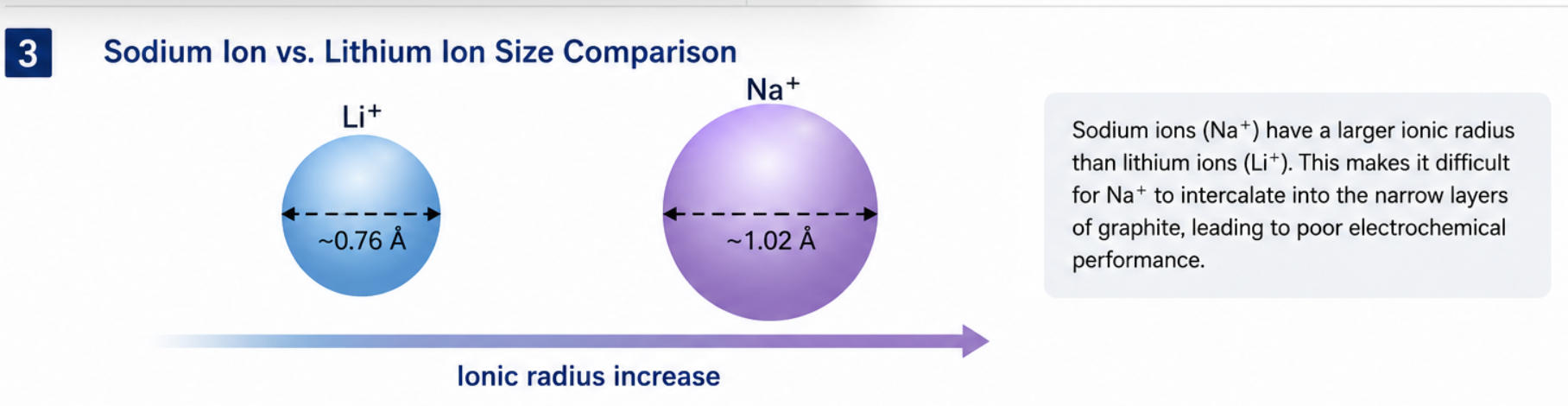
The larger ionic radius of sodium makes it difficult for sodium ions to reversibly intercalate into graphite layers under standard electrolyte conditions.
As a result, graphite typically exhibits:
- Very low reversible sodium storage capacity
- Poor cycling stability
- Limited sodium intercalation behavior
In many carbonate-based electrolytes, graphite delivers almost negligible sodium storage performance.
This limitation mainly originates from:
- insufficient graphite interlayer spacing
- unfavorable thermodynamics for sodium intercalation
- slow sodium diffusion kinetics
Although some ether-based electrolyte systems have shown partial improvements, graphite is still generally considered unsuitable for practical sodium-ion battery anodes.
Why Hard Carbon Is Better for Sodium-Ion Batteries
Hard carbon has a highly disordered microstructure compared with graphite.
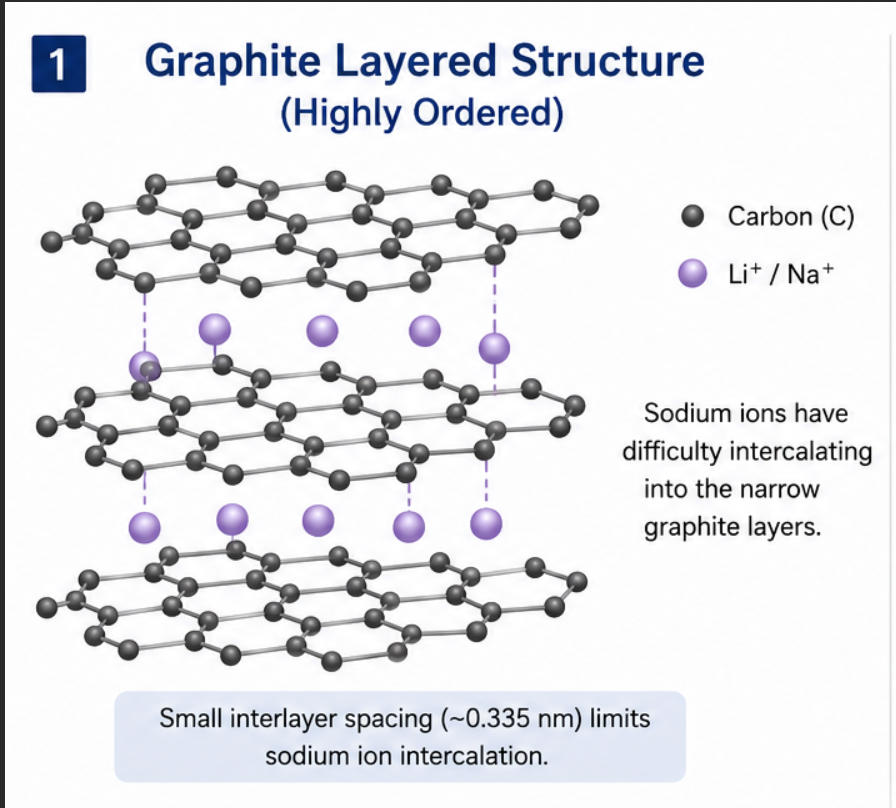
Instead of perfectly aligned graphene layers, hard carbon contains:
- enlarged interlayer spacing
- nanopores
- defects
- turbostratic carbon domains
These structural features allow sodium ions to be stored through multiple mechanisms, including:
- adsorption on defect sites
- pore filling
- interlayer insertion
The larger spacing between carbon layers significantly improves sodium storage capability.
Hard carbon typically demonstrates:
- higher reversible sodium capacity
- better sodium storage behavior
- improved low-temperature performance
- good compatibility with sodium-ion systems
Because of these advantages, hard carbon is currently regarded as one of the leading anode candidates for commercial sodium-ion batteries.
Sodium Storage Mechanism Comparison
The sodium storage mechanisms of graphite and hard carbon are fundamentally different.
Graphite
Sodium storage mainly relies on intercalation between highly ordered graphene layers.
However, due to the large sodium ion radius, this process is thermodynamically unfavorable.
Hard Carbon
Hard carbon stores sodium through a combination of:
- surface adsorption
- pore filling
- interlayer insertion
This multi-mechanism storage behavior enables significantly higher sodium storage capacity.
Researchers generally attribute the sloping voltage region to adsorption processes and the plateau region to pore filling mechanisms.
Hard Carbon vs Graphite Comparison Table
| Property | Graphite | Hard Carbon |
|---|---|---|
| Structure | Highly ordered | Disordered |
| Interlayer Spacing | Small | Larger |
| Sodium Storage Capability | Poor | Excellent |
| Lithium-Ion Compatibility | Excellent | Moderate |
| Sodium-Ion Compatibility | Limited | Excellent |
| Commercial Use in SIBs | Low | High |
| Low-Temperature Performance | Limited | Better |
| Typical Reversible Capacity in SIBs | Very low | High |
Current Challenges of Hard Carbon
Although hard carbon shows strong potential for sodium-ion batteries, several technical challenges still remain.
1. Low Initial Coulombic Efficiency (ICE)
Hard carbon often suffers from irreversible sodium loss during the first cycle due to:
- SEI formation
- sodium trapping in micropores
- surface side reactions
Improving ICE remains one of the most important research topics.
2. Structural Consistency
The electrochemical performance of hard carbon strongly depends on:
- precursor selection
- pyrolysis temperature
- pore structure
- surface chemistry
Achieving consistent large-scale production can be challenging.
3. Tap Density Optimization
Some hard carbon materials have relatively low tap density, which can reduce volumetric energy density.
Balancing porosity and density is important for practical applications.
Future Outlook of Hard Carbon for Sodium-Ion Batteries
Sodium-ion batteries are increasingly considered promising for:
- grid-scale energy storage
- renewable energy integration
- low-cost stationary storage systems
Compared with lithium resources, sodium is more abundant and potentially lower in cost.
As commercialization accelerates, demand for high-performance hard carbon materials is expected to continue growing.
Current research trends focus on:
- biomass-derived hard carbon
- high ICE materials
- low-defect structures
- fast-charging sodium-ion systems
Several battery manufacturers and research institutions are actively developing advanced hard carbon technologies for next-generation sodium-ion batteries.
Research-Grade Hard Carbon Materials
Selecting suitable hard carbon materials is critical for sodium-ion battery research and development.
Oneenergi supplies research-grade hard carbon materials for sodium-ion battery applications, including customized solutions for:
- high ICE optimization
- low-temperature performance
- biomass-derived hard carbon
- fast sodium diffusion systems
Customized material solutions based on particle size distribution, tap density, and electrochemical requirements can help accelerate sodium-ion battery development projects.
Conclusion
Although graphite remains the dominant anode material for lithium-ion batteries, it performs poorly in most sodium-ion battery systems because of unfavorable sodium intercalation behavior.
Hard carbon, with its disordered structure and enlarged interlayer spacing, provides significantly better sodium storage capability and has become one of the most promising anode materials for sodium-ion batteries.
As sodium-ion technology continues to evolve, advanced hard carbon materials are expected to play a key role in future large-scale energy storage applications.
Explore our hard carbon materials for sodium-ion battery research.