

Biomass-Derived Hard Carbon for Sodium-Ion Batteries: Advantages, Challenges and Future Prospects
Introduction
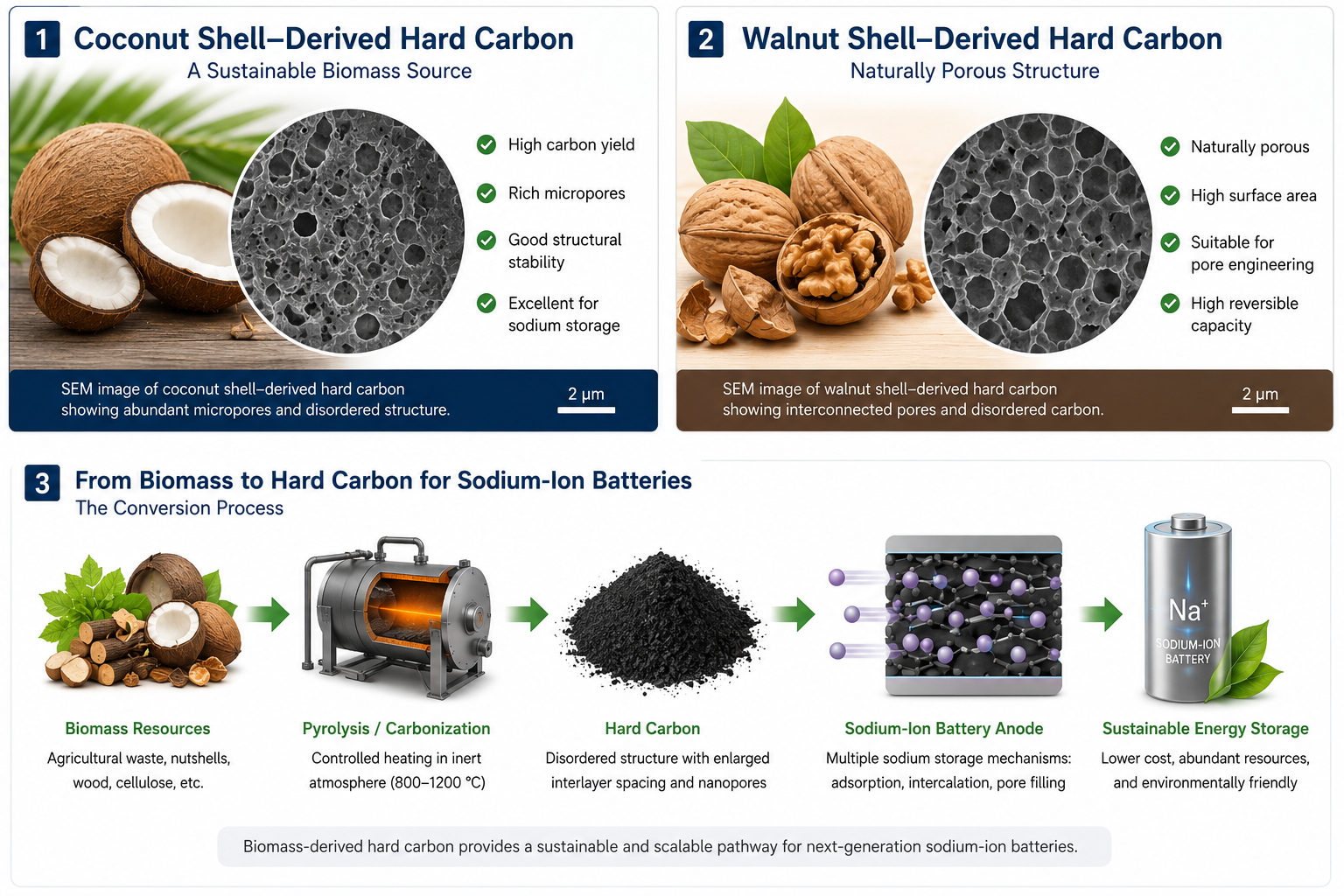
Figure 1. Examples of biomass-derived hard carbon precursors and the conversion pathway from biomass resources to sodium-ion battery anode materials.
As sodium-ion batteries continue to gain attention as a cost-effective alternative to lithium-ion technology, the demand for high-performance anode materials is growing rapidly. Among various candidates, hard carbon has emerged as one of the most promising anode materials due to its excellent sodium storage capability and compatibility with commercial sodium-ion battery systems.
In recent years, researchers have increasingly focused on biomass-derived hard carbon. Agricultural waste, forestry by-products, and natural biomass resources can be converted into functional carbon materials through controlled pyrolysis processes. This approach not only reduces material costs but also supports the development of more sustainable energy storage technologies.
This article explores the advantages, challenges, and future opportunities of biomass-derived hard carbon for sodium-ion batteries.
Why Biomass Is Attractive for Hard Carbon Production
Biomass offers several unique advantages as a precursor for hard carbon synthesis.
Abundant and Renewable Resources
Unlike synthetic carbon precursors, biomass is widely available around the world. Materials such as coconut shells, walnut shells, wood, bamboo, cellulose, and agricultural waste can serve as low-cost carbon sources.
Lower Environmental Impact
Using biomass helps utilize waste materials that would otherwise be discarded or burned. Converting these resources into battery materials contributes to a more sustainable and circular economy.
Naturally Developed Carbon Structures
Many biomass materials possess unique microstructures that can be beneficial for sodium storage after carbonization. Proper processing can create suitable pore structures and enlarged interlayer spacing for sodium-ion insertion.
Cost Advantages
The raw material cost of biomass precursors is generally much lower than that of many synthetic carbon sources, making them attractive for future large-scale energy storage applications.
Common Biomass Precursors for Hard Carbon
Various biomass sources have been investigated for sodium-ion battery applications.
| Biomass Source | Key Advantages | Carbon Yield | Cost | Research Popularity |
| Coconut Shell | High carbon yield and good structural stability | High | Low | High |
| Walnut Shell | Naturally porous structure | Medium | Low | High |
| Bamboo | Fast-growing and widely available | Low to Medium | Low | High |
| Wood | Low cost and abundant supply | Medium | Very Low | Medium |
| Cellulose | High purity and controllable processing | High | Medium | High |
| Agricultural Waste | Sustainable and economical | Low | Very Low | High |
The final electrochemical performance depends not only on the precursor itself but also on carbonization temperature, activation methods, and post-treatment processes.
How Biomass-Derived Hard Carbon Stores Sodium
After carbonization, biomass-derived hard carbon typically develops a disordered carbon structure with enlarged interlayer spacing compared with graphite.. To understand why graphite fails while hard carbon succeeds in sodium storage, you can read our detailed guide on Hard Carbon vs Graphite for Sodium-Ion Batteries Explained.
This structure provides multiple sodium storage pathways, including:
- Surface adsorption on defects and active sites
- Sodium insertion between carbon layers
- Sodium storage within nanopores
These mechanisms enable significantly higher sodium storage capacity than conventional graphite under most sodium-ion battery conditions.
Challenges of Biomass-Derived Hard Carbon
Despite its advantages, biomass-derived hard carbon still faces several challenges.
Material Consistency
One of the biggest challenges is maintaining consistent quality.
Natural biomass sources can vary depending on:
- Geographic origin
- Growth conditions
- Moisture content
- Chemical composition
These variations can affect electrochemical performance and make large-scale production more difficult.
Initial Coulombic Efficiency (ICE)
Many biomass-derived hard carbon materials exhibit relatively low Initial Coulombic Efficiency due to:
- High surface area
- Abundant micropores
- Surface functional groups
Improving ICE remains a major research focus for commercial sodium-ion battery development. For a deeper dive into the specific engineering strategies and material treatments used to overcome this bottleneck, check out our comprehensive analysis on How to Improve Initial Coulombic Efficiency (ICE) of Hard Carbon for Sodium-Ion Batteries.
Impurity Control
Certain biomass precursors contain mineral impurities that may negatively affect battery performance. Additional purification and processing steps are often required.
Scale-Up Challenges
Laboratory-scale results do not always translate directly to industrial production. Developing cost-effective and reproducible manufacturing processes remains essential for commercialization.
Recent Research Progress
Researchers are actively developing advanced strategies to improve biomass-derived hard carbon performance.
Current research directions include:
- Optimizing carbonization temperatures
- Controlling pore structures
- Surface modification techniques
- Heteroatom doping
- Electrolyte compatibility optimization
These approaches aim to achieve higher reversible capacity, improved ICE, and longer cycle life.
Several recent studies have demonstrated that biomass-derived hard carbon can achieve electrochemical performance comparable to or even exceeding some synthetic hard carbon materials.
Commercial Potential
The commercial outlook for biomass-derived hard carbon is highly promising.
As sodium-ion batteries move toward applications such as:
- Grid energy storage
- Renewable energy integration
- Residential storage systems
- Low-cost transportation solutions
there is growing demand for sustainable and scalable anode materials.
Biomass-derived hard carbon offers a potential pathway to reduce production costs while supporting environmental sustainability goals.
Conclusion
Biomass-derived hard carbon represents an exciting opportunity for the future development of sodium-ion batteries.
Its renewable nature, low cost, and favorable sodium storage characteristics make it an attractive alternative to conventional carbon materials. Although challenges remain in terms of consistency, ICE, and industrial scale-up, ongoing research continues to improve performance and manufacturing reliability.
As sodium-ion battery technology advances, biomass-derived hard carbon is expected to play an increasingly important role in next-generation energy storage systems.