

How to Choose the Right Electrolyte for NFPP Sodium-Ion Batteries
Introduction
Electrolyte matching for NFPP (Sodium Iron Fluorophosphate) cathode systems is a critical multi-variable optimization process that directly governs the initial coulombic efficiency (ICE), solid electrolyte interphase (SEI) stability, and long-term cycle life of sodium-ion batteries.
NFPP is a cathode material, but its performance cannot be separated from the electrolyte. In sodium-ion battery testing, electrolyte selection can influence capacity, cycle life, rate performance, gas generation, interface stability, and safety.
For customers testing NFPP cathode materials, choosing the right sodium-ion electrolyte is just as important as choosing the cathode powder itself.
This article explains the main factors to consider when selecting electrolyte for NFPP sodium-ion batteries.
Why Electrolyte Matching Matters for NFPP
The electrolyte is responsible for transporting sodium ions between the cathode and anode. It also participates in the formation of electrode interfaces.
In an NFPP-based sodium-ion battery, the electrolyte must work with:
- NFPP cathode
- Hard carbon anode or other anode material
- Separator
- Binder
- Conductive additive
- Current collectors
- Formation process
- Operating voltage range
If the electrolyte is not suitable, even a good NFPP cathode material may show poor performance.
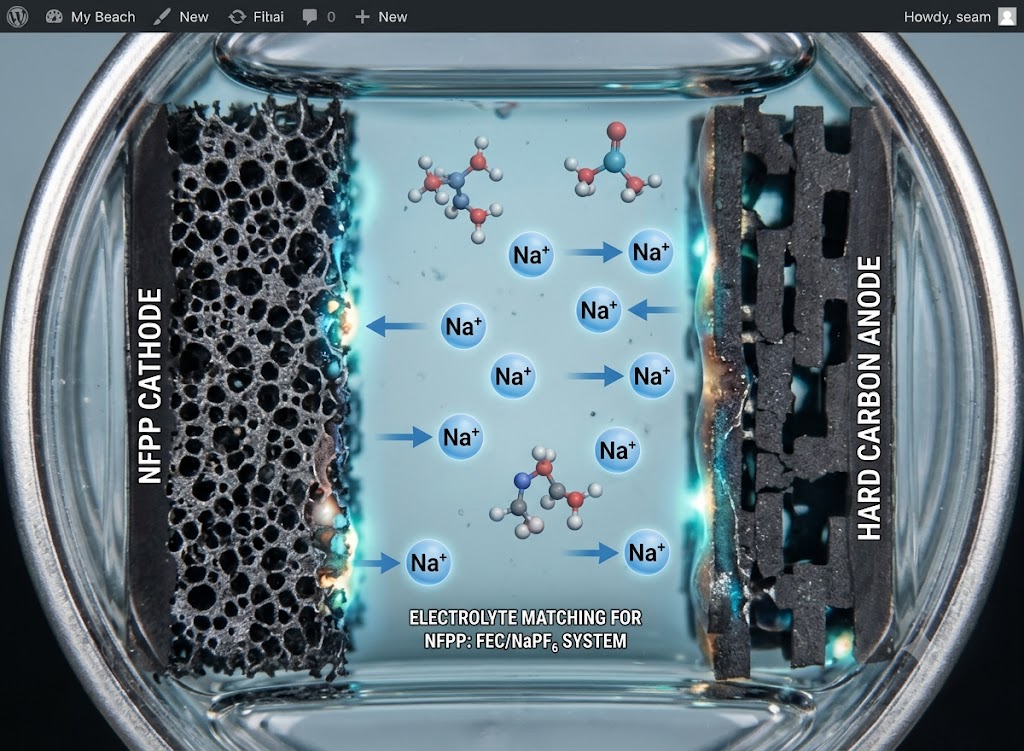
Figure 1: Schematic illustration of sodium-ion migration and electrolyte interface matching between an NFPP cathode and a hard carbon anode system.
Key Factors When Choosing Electrolyte for NFPP
1. Sodium Salt Type(NaPF6,NaFSi, etc.)
Sodium-ion electrolytes use sodium salts instead of lithium salts. The sodium salt affects ionic conductivity, electrochemical stability, interface formation, cost, and safety.
Customers should ask which sodium salt is used and whether it is suitable for their target voltage range and anode system.
2. Solvent System(EC/DEC/PC,etc.)
The solvent system affects viscosity, conductivity, low-temperature performance, wetting behavior, and electrode interface stability.
While cyclic carbonates like EC/PC are widely utilized, ether-based solvents (such as diglyme or triglyme) are increasingly researched for their superior low-temperature performance and low solvation energy with sodium ions.
Different solvent systems may perform differently with NFPP cathode and hard carbon anode. Some formulations may support better rate performance, while others may improve cycling or safety.
3. Additive Package(Featuring FEC)
Electrolyte additives can play an important role in interface formation and long-term stability. They may help improve the cathode-electrolyte interface, support hard carbon SEI formation, reduce side reactions, or improve cycle life.
Targeted electrolyte additives, such as fluoroethylene carbonate (FEC), play an indispensable role in forming a stable solid electrolyte interphase (SEI) and ensuring long-term electrochemical stability.
However, additive selection must be based on the full cell system. An additive that works well in one sodium-ion battery chemistry may not be suitable for another.
4. Voltage Stability
The electrolyte must remain stable within the operating voltage window of the NFPP cathode system. If the upper voltage is too high for the electrolyte, oxidation and side reactions may occur.
Before choosing electrolyte, customers should confirm:
- Recommended NFPP voltage range
- Electrolyte oxidation stability
- Full-cell voltage range
- Target application
- Testing temperature
5. Compatibility With Hard Carbon Anode
Many sodium-ion batteries use hard carbon as the anode material. A suitable electrolyte for NFPP should also support stable hard carbon interface formation.
Hard carbon performance can be affected by electrolyte salt, solvent, additives, moisture, and formation protocol. Therefore, electrolyte selection should not focus only on the cathode side.
6. Moisture Control
Moisture is a critical factor in sodium-ion electrolyte and battery material handling. Excess moisture may lead to side reactions and unstable performance.
Customers should pay attention to:
- Strict Moisture Thresholds: Sodium-ion electrolytes for NFPP typically require ultra-low moisture levels (strictly under 20 ppm, or ideally <10 ppm) to prevent severe gas generation and active sodium consumption.
- Packaging method
- Storage condition
- Opening and handling process
- Dry-room or glovebox requirements
- Electrode drying process
7. Separator Wetting
The electrolyte must wet the separator and electrodes properly. Poor wetting may lead to high internal resistance, inconsistent cycling, and poor cell performance.
When evaluating electrolyte, customers should check whether it is suitable for the selected separator and electrode design.
What Information Should Customers Provide Before Asking for Electrolyte Recommendation?
To recommend electrolyte for NFPP testing, suppliers usually need the following information:
- Cathode material type: NFPP, carbon-coated NFPP, or other grade
- Anode material: hard carbon or other anode
- Cell format: coin cell, pouch cell, cylindrical cell, or Three-electrode cell
- Voltage range
- Testing temperature
- Target application
- Capacity loading
- Cycle life target
- Rate performance requirement
- Separator type
- Any previous test problems
The more information the customer provides, the easier it is to recommend a suitable electrolyte.
Common Problems Related to Electrolyte Selection
When electrolyte is not well matched, customers may observe:
- Low initial capacity
- High irreversible capacity
- Fast capacity fading
- High impedance
- Gas generation
- Poor rate performance
- Unstable cycling
- Large performance difference between batches
These issues may not always come from the electrolyte alone, but electrolyte should always be part of the troubleshooting process.
Should Customers Use a Standard Sodium-Ion Electrolyte First?
For initial testing, a standard sodium-ion electrolyte can be useful as a starting point. It helps customers screen NFPP material under a common condition.
For deeper development, customized electrolyte optimization may be needed. This is especially true when customers move from half-cell testing to full-cell testing, or from coin cell to pouch cell.
How One-Stop Supply Helps Electrolyte Matching
Electrolyte selection becomes easier when the supplier understands the complete material system. A one-stop battery material supplier can help customers coordinate:
- NFPP cathode
- Hard carbon anode
- Sodium-ion electrolyte
- Separator
- Binder
- Conductive additive
- Current collector
- Technical communication
This can reduce sourcing time and improve testing efficiency.
Conclusion
Choosing the right electrolyte for NFPP sodium-ion batteries requires system-level thinking. Customers should consider sodium salt, solvent system, additives, voltage stability, hard carbon compatibility, moisture control, and separator wetting.
The electrolyte should be selected according to the customer’s actual testing conditions and application goals.
Looking for sodium-ion electrolyte for NFPP testing?
OneEnergi can support sodium-ion electrolyte, NFPP cathode material, hard carbon anode, and related auxiliary materials for sodium-ion battery development.