

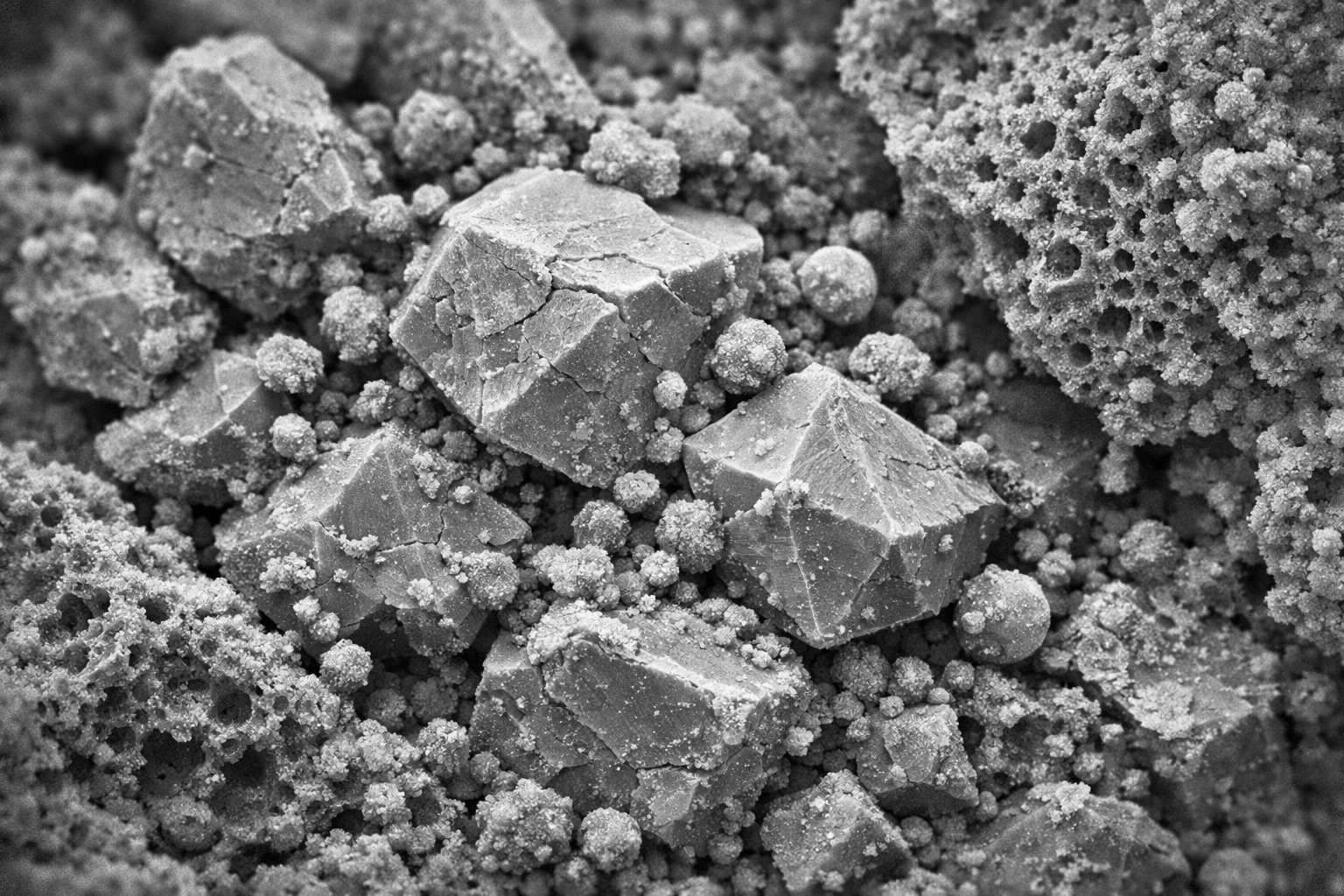
What Is NFPP Cathode Material ?
NFPP is a polyanionic cathode material belonging to the pyrophosphate family, with the chemical formula Na₂FeP₂O₇ (often synthesized as a stable framework like Na₄Fe₃(PO₄)₂P₂O₇).
Introduction
As sodium-ion batteries move from laboratory research toward commercial applications, the search for safer, lower-cost, and more sustainable cathode materials has become increasingly important.
Among the emerging cathode chemistries, NFPP (Sodium Iron Pyrophosphate, Na₂FeP₂O₇) has attracted significant attention due to its excellent thermal stability, long cycle life, and the use of abundant, low-cost elements.
Compared with layered oxide cathodes, NFPP offers superior structural stability, while providing a higher operating voltage than many traditional polyanionic compounds. These characteristics make it a promising candidate for large-scale energy storage systems and next-generation sodium-ion batteries.
This article provides an overview of NFPP cathode materials, including their crystal structure, electrochemical properties, advantages, current challenges, and future development trends.
What Is NFPP?
NFPP is a polyanionic cathode material with the chemical formula Na₂FeP₂O₇.
Unlike layered oxide cathodes, NFPP belongs to the pyrophosphate family. Its three-dimensional crystal framework provides excellent structural stability during repeated sodium insertion and extraction.
The material offers several attractive characteristics:
- High operating voltage
- Excellent thermal stability
- Long cycle life
- Good safety performance
- Iron-based composition with relatively low raw material cost
Because iron and phosphorus are abundant and environmentally friendly, NFPP has become an attractive alternative to cathodes containing nickel or cobalt.
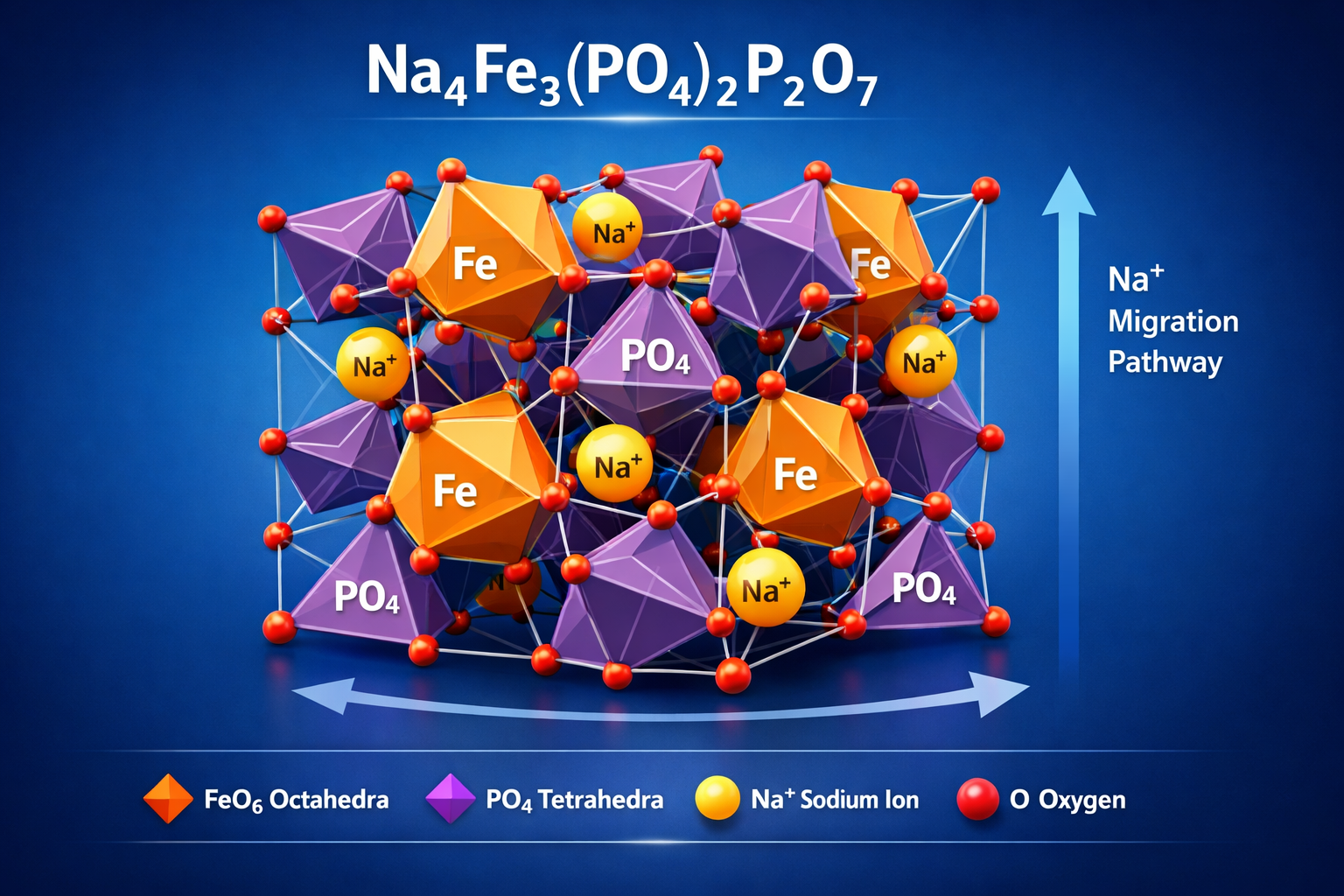
Figure 1. Crystal structure of NFPP (Na₄Fe₃(PO₄)₂P₂O₇), illustrating the arrangement of FeO₆ octahedra, PO₄ tetrahedra, and the Na⁺ migration pathways within the framework.
How Does NFPP Store Sodium Ions?
During battery operation, sodium ions move reversibly between the anode and the NFPP cathode.
The robust pyrophosphate framework helps maintain structural integrity throughout repeated charge and discharge cycles.
Compared with many layered oxide materials, NFPP generally exhibits:
- Better structural stability
- Lower volume change during cycling
- Improved long-term cycling performance
These characteristics contribute to excellent durability, particularly for stationary energy storage applications.
| Technical Parameter | Typical Value / Range | Why It Matters for Battery Design |
| Operating Voltage | ~3.0 V (vs. $Na/Na^+$) | Offers a stable plateau for battery balancing. |
| Theoretical Capacity | ~120 mAh/g | Perfect balance for stationary storage applications. |
| Volume Change | Ultra-Low (< 2% during cycling) | Ensures years of degradation-free operation. |
| Primary Target Market | Grid Storage (ESS), Telecom Power | Maximizes safety and cost efficiency. |
Key Advantages of NFPP Cathode Materials
1. Why NFPP Offers Exceptional Thermal Safety
The strong P–O covalent bonds within the polyanionic framework improve thermal stability and reduce the risk of oxygen release at elevated temperatures.
This contributes to enhanced battery safety compared with many layered oxide cathodes.
2. How the Rigid Framework Enables Ultra-Long Cycle Life
The stable crystal structure minimizes structural degradation during repeated cycling.
As a result, NFPP-based cells often demonstrate excellent capacity retention over extended charge-discharge cycles.
3. Why NFPP Has the Lowest Raw Material Cost Structure
NFPP uses iron as its primary transition metal.
Compared with nickel-rich cathodes, iron is significantly more abundant and economical, making NFPP attractive for large-scale commercialization.
4. What is the Optimized Voltage Plateau of NFPP?
NFPP typically operates around 3.0 V versus Na/Na⁺, offering a good balance between energy density, safety, and cycling stability.
This voltage range makes it suitable for various sodium-ion battery applications.
Current Challenges of NFPP
Despite its many advantages, NFPP still faces several technical challenges.
Low Electronic Conductivity
Like many phosphate-based cathode materials, NFPP has relatively low intrinsic electronic conductivity.
To overcome this limitation, researchers commonly employ:
- Carbon coating
- Particle size optimization
- Conductive additives
- Composite electrode design
Rate Performance Optimization
Although NFPP delivers excellent cycling stability, improving high-rate performance remains an active research area.
Strategies under investigation include nanostructure engineering and optimized electrode architectures.
Electrolyte Compatibility
Electrolyte selection significantly influences NFPP performance.
Researchers continue to study electrolyte formulations that can improve:
- Initial Coulombic Efficiency
- Interface stability
- Long-term cycling performance
Selecting an appropriate sodium salt and electrolyte additive is essential for maximizing cell performance.
Applications of NFPP in Sodium-Ion Batteries
Due to its safety and cycling stability, NFPP is particularly attractive for:
- Grid-scale energy storage systems (ESS)
- Renewable energy integration
- Residential energy storage
- Backup power systems
- Low-speed electric mobility
As sodium-ion battery commercialization accelerates, these applications are expected to become major growth markets for NFPP.
Future Development Trends
Current research focuses on enhancing NFPP performance through:
- Advanced carbon coating technologies
- Particle morphology control
- Composite cathode design
- Electrolyte optimization
- Full-cell performance improvement
These developments aim to further improve energy density while maintaining the excellent safety and durability that make NFPP attractive.
Choosing High-Quality NFPP Materials
For researchers and battery developers, material consistency is just as important as electrochemical performance.
Key considerations include:
- Phase purity
- Particle size distribution
- Carbon coating quality
- Tap density
- Batch-to-batch consistency
Reliable material quality helps ensure reproducible research results and accelerates product development.
Conclusion
NFPP has emerged as one of the most promising cathode materials for sodium-ion batteries by combining excellent safety, long cycle life, and cost-effective raw materials.
Although challenges such as electronic conductivity and electrolyte optimization remain, continuous research is driving significant improvements in electrochemical performance.
As sodium-ion batteries move closer to commercial deployment, NFPP is expected to play an increasingly important role in building safer, more sustainable, and more affordable energy storage systems.
Looking for research-grade NFPP cathode materials? Explore our NFPP product page.